
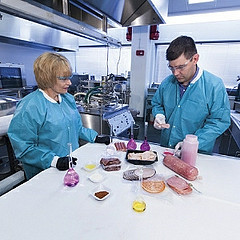
Our research focus is an extension of the teaching mission. Teaching is about guiding students’ curiosity. Research is about freeing our curiosity – to see what everyone else has seen, but think about it in ways that no one else has.
The new facility will promote innovative research in:
• Meat and Poultry Production with a state of the art, slaughter-to-package, Federally inspected meat processing facility
• Food Safety in the adjoining isolatable BSL-2 laboratory
• Improving livestock production & human health with state of the art tissue collection and processing facilities
•Value-added animal bio-products (adding value to the non-meat portion of a carcass)
The strong research dimension of MSABD has attracted top talent. After the Oscar Mayer plant in Madison closed, UW-Madison alum Cindy Austin joined MSABD as the first manager of the BSL-2 lab. She brings with her close to two decades of industry experience. In addition, Dr. Steven Ricke and Dr. Vanessa Leone have returned to UW-Madison as faculty after having previously attended the University for schooling.
Today research at MSABD is wide ranging and longitudinal – from farm to fork, or live animal to ready-to-eat product – and impacts all parts of the agricultural community. Located on the West end of campus, MSABD actively collaborates with other departments within the University, including the departments of Animal & Dairy Science, Bacteriology, Biochemistry, Food Science, Nutritional Sciences, and Biological Systems Engineering. Beyond Madison, MSABD collaborates with universities across Wisconsin, the United States, Canada, Ireland, Australia, and more.
In 2021 – 2022, researchers at MSABD published nearly 60 research papers. Below are some of the topics explored.
- Captive bolt placement
- Antimicrobials in uncured beef frankfurters
- Hexanal as an indicator of development of oxidation flavor
- Gut microbiology on broiler performance
- Antimicrobial resistance
- Characterizing the different in carcass color in small versus large birds
- Probiotics for poultry production systems
- Food waste
- The impact of fats in diet
- Caffeic acid as an antioxidant with antisickling properties
- Vascular rinses for hogs
- Vascular rinsing and chilling effects on meat quality in dairy cows
- Steroids effect on muscle development and function
- Nutrition on heart health
- Thermal processing on pathogens
- The genes that regulate skeletal muscle development and growth in farm animals
- Viruses to limit campylobacter in poultry production
- The benefits of salt in frankfurters
- How to communicate bioinformatics with small flock poultry growers
- Preventing lipid oxidation of trout hemoglobin and hemin
- The circadian rhythms in mice lacking a microbiome
- Color stability and lipid oxidation in pork sausage
- Quercetin as an inhibitor of lipid oxidation – the mechanism of action and molecular docking
- Free fatty acids on lipid oxidation in turkey
- Cetypyridinium chloride application to reduce salmonella and the impact on skin microbiota
- The bonding of phosphorus and its role in heart disease