Guo Lab Paper Featured as Editor’s Pick in JCI Insight

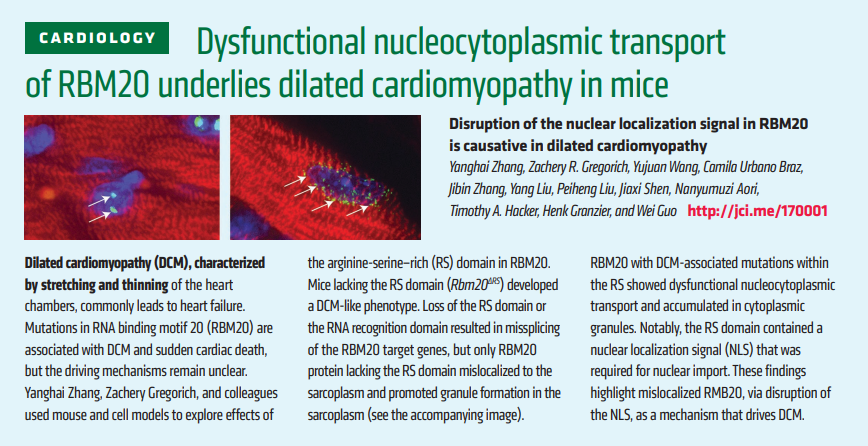
    A screenshot of Dr. Guo's article in JCI Insight. The text reads: Dysfunctional nucleocytoplasmic transport of RBM20 underlies dilated cardiomyopathy in mice Disruption of the nuclear localization signal in RBM20 is causative in dilated cardiomyopathy Yanghai Zhang, Zachery R. Gregorich, Yujuan Wang, Camila Urbano Braz, Jibin Zhang, Yang Liu, Peiheng Liu, Jiaxi Shen, Nanyumuzi Aori, Timothy A. Hacker, Henk Granzier, and Wei Guo http://jci.me/170001 Dilated cardiomyopathy (DCM), characterized by stretching and thinning of the heart chambers, commonly leads to heart failure. Mutations in RNA binding motif 20 (RBM20) are associated with DCM and sudden cardiac death, but the driving mechanisms remain unclear. Yanghai Zhang, Zachery Gregorich, and colleagues used mouse and cell models to explore effects of the arginine-serine–rich (RS) domain in RBM20. Mice lacking the RS domain (Rbm20ΔRS) developed a DCM-like henotype. Loss of the RS domain or the RNA recognition domain resulted in missplicing of the RBM20 target genes, but only RBM20 protein lacking the RS domain mislocalized to the sarcoplasm and promoted granule formation in the sarcoplasm (see the accompanying image). RBM20 with DCM-associated mutations within the RS showed dysfunctional nucleocytoplasmic transport and accumulated in cytoplasmic granules. Notably, the RS domain contained a nuclear localization signal NLS) that was required for nuclear import. These findings highlight mislocalized RMB20, via disruption of the NLS, as a mechanism that drives DCM.

    A new paper from the Guo Lab was published in the August 2023 issue of the Journal of Clinical Investigation (JCI) Insight. The paper, titled “Dysfunctional nucleocytoplasmic transport of RBM20 underlies dilated cardiomyopathy in mice”, describes research findings on the mechanisms that drive dilated cardiomyopathy. According to the American Hearth Association, dilated cardiomyopathy is the most common type of cardiomyopathy, a heart muscle disease that “makes it harder for the heart to pump blood to the rest of the body.” The paper was highlighted in the issue as one of the editor’s picks. JCI Insight is a Gold Open Access journal and publishes “well-executed, high-quality studies that provide meaningful contributions to the understanding of the biology and/or treatment of disease, . . .” To view the August 2023 issue and Dr. Guo’s paper, please visit: JCI Insight – August 2023.